How to Calculate How Many Litres Are in a Swimming Pool
To calculate how many litres are in your swimming pool, start by accurately measuring its length, width, and average depth. These dimensions are crucial for determining the pool’s volume in cubic meters.
For rectangular pools, multiply the length by the width and the depth. If your pool is circular, calculate the area by squaring the radius, multiplying by pi, and then by the depth. Oval pools require multiplying the length, width, depth, and 0.785 together.
After finding the volume in cubic meters, convert it to litres by multiplying by 1,000. Be sure to consider any irregular shapes or water displacement to improve accuracy. Keep going, and you’ll find how to make your measurements even more precise.
Understanding Pool Volume Basics

How do you determine the amount of water your pool holds? It starts with understanding pool volume basics. The volume is the total space inside your pool that water occupies, typically measured in litres. Knowing this helps you manage water treatments, heating, and maintenance effectively.
Pools come in various shapes and sizes, but all have one thing in common: volume depends on the shape and dimensions. You’ll need to know the pool’s shape type—rectangular, circular, or irregular—to apply the right calculation formula.
Volume is fundamentally the product of surface area and average depth. Once you grasp these basics, you’ll be ready to measure your pool’s dimensions accurately and calculate the exact litres it holds without guesswork.
Measuring Pool Length, Width, and Depth

Where should you begin when measuring your pool’s dimensions? Start by measuring the length from one end to the other, ensuring your tape measure is straight and level.
Next, measure the width across the pool at its widest point. For irregular shapes, take multiple width measurements and note them down.
Then, move on to the depth. If your pool has a uniform depth, measure from the surface to the bottom at several points to confirm consistency.
For pools with varying depths, measure both the shallow and deep ends separately. Accurate measurements here are essential because even small errors can considerably affect your volume calculation.
Keep your measurements handy; they’ll be vital for determining your pool’s capacity in litres.
Calculating Volume for Rectangular Pools
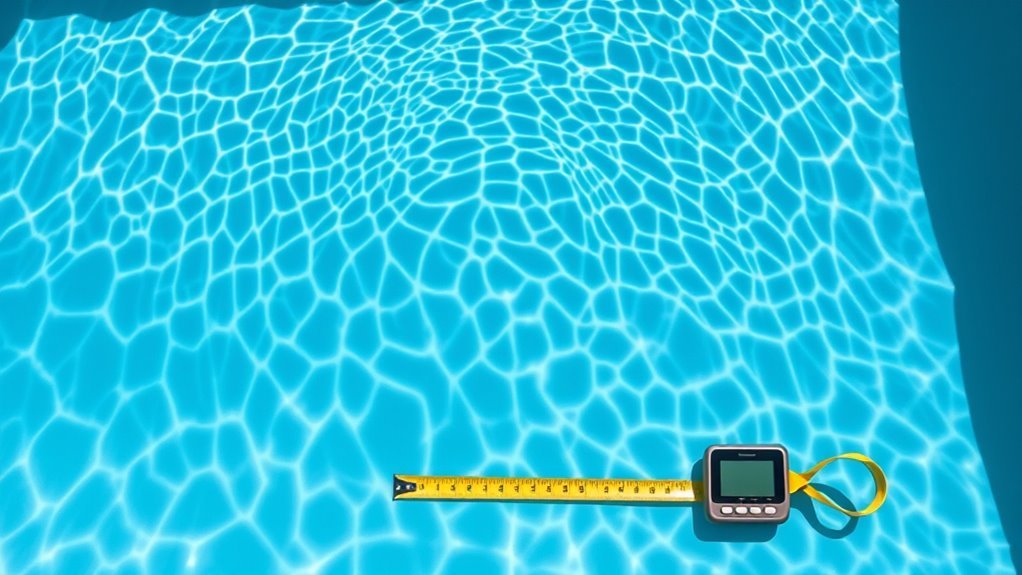
Once you have your pool’s length, width, and depth measurements, you can calculate the volume for rectangular pools with a straightforward formula. Multiply length × width × depth to get the volume in cubic meters.
Then, convert cubic meters to litres by multiplying by 1,000, since 1 cubic meter equals 1,000 litres.
| Length (m) | Width (m) | Depth (m) | Volume (m³) | Volume (L) |
|---|---|---|---|---|
| 5 | 3 | 1.5 | 22.5 | 22,500 |
| 8 | 4 | 2 | 64 | 64,000 |
| 10 | 5 | 1.2 | 60 | 60,000 |
| 6 | 3.5 | 2.5 | 52.5 | 52,500 |
This method gives you an accurate litre count for your rectangular pool.
Calculating Volume for Circular Pools
Although circular pools have a different shape than rectangular ones, you can still calculate their volume with a simple formula. First, measure the diameter of your pool, then divide it by two to find the radius.
Next, square the radius (multiply it by itself). Then, multiply this result by pi (approximately 3.1416) to find the area of the pool’s surface.
After that, measure the average depth of your pool and multiply it by the surface area to get the volume in cubic meters.
Finally, convert cubic meters to litres by multiplying by 1,000 since one cubic meter equals 1,000 litres.
This method gives you a precise estimate of how much water your circular pool holds, helping you manage maintenance and water treatment effectively.
Calculating Volume for Oval Pools
Calculating the volume of an oval pool involves a slightly different approach than a circular one due to its elongated shape.
Calculating an oval pool’s volume requires a unique method because of its distinctive elongated design.
To find out how many litres your oval pool holds, follow these steps:
- Measure the longest length (L) and the widest width (W) of the pool in meters.
- Measure the average depth (D) by adding the shallow and deep ends, then dividing by two.
- Use the formula: Volume (m³) = L × W × D × 0.785, where 0.785 approximates the oval shape.
- Convert cubic meters to litres by multiplying the volume by 1,000.
This method guarantees you get an accurate estimate of your oval pool’s capacity without complex calculations.
Calculating Volume for Kidney-Shaped Pools
When you want to find out how many litres your kidney-shaped pool holds, you’ll need to account for its unique contours. First, divide the pool into two sections: the larger rounded end and the smaller curved end.
Measure the length and width of each section, then calculate each area separately using the formula for an ellipse (Area = π × semi-major axis × semi-minor axis).
Add the two areas together for the total surface area.
Next, take several depth measurements along the pool, calculate the average depth, and multiply it by the total surface area to find the volume in cubic meters.
This approach captures the irregular shape accurately, giving you a reliable figure to work with for your pool’s volume.
Converting Cubic Meters to Litres
Since pool volume is often measured in cubic meters, you’ll need to convert this figure into litres to understand exactly how much water your pool holds.
Fortunately, the conversion is straightforward because 1 cubic meter equals 1,000 litres. Here’s how you do it:
- Note the pool’s volume in cubic meters.
- Multiply that number by 1,000.
- The result is the total litres of water your pool contains.
- Use this litre value for maintenance, chemical dosing, or filling purposes.
For example, if your pool measures 12 cubic meters, multiply 12 by 1,000 to get 12,000 litres.
This simple step guarantees you’re working with the right units and can manage your pool effectively.
Adjusting for Pool Shape Irregularities
How do you handle pools that don’t fit standard shapes? Start by breaking down the pool into smaller, regular sections like rectangles, circles, or triangles. Measure each section’s dimensions carefully, then calculate their volumes individually.
For instance, if you have a kidney-shaped pool, split it into two overlapping circles or ovals. Add these volumes together to get a close approximation of the total volume.
If the pool has uneven depths, measure the depth at several points and calculate an average depth for each section. Multiply the surface area by the average depth for each part.
This method helps you account for irregular shapes without complicated formulas, giving you a reliable litre estimate. Always double-check your measurements to minimize errors.
Considering Water Displacement Factors
Although calculating your pool’s volume gives you a solid estimate, you’ll need to account for water displacement factors to get an accurate litre measurement. Objects in the pool reduce the actual water volume, so consider these common displacements:
- Pool equipment: Ladders, diving boards, and slides take up space.
- Pool accessories: Floats, toys, and cleaning tools displace water.
- Built-in features: Steps, benches, and ledges affect volume.
- Water level changes: Evaporation or partial filling alters water quantity.
Tips for Accurate Measurement and Calculation
To get the most accurate pool volume, you’ll want to measure carefully and double-check your calculations. Start by using a reliable tape measure to get the pool’s length, width, and average depth.
If your pool has an irregular shape, break it down into simpler sections and measure each one separately. Write down all dimensions clearly to avoid confusion.
Use a calculator or spreadsheet to minimize math errors when multiplying dimensions and converting cubic meters to litres. Remember, 1 cubic meter equals 1,000 litres.
Don’t forget to factor in any shallow areas or steps, as they affect total volume.
Finally, review your measurements and formula once more to catch mistakes.
Taking these steps ensures your pool’s water volume estimate is as precise as possible.
Frequently Asked Questions
How Often Should I Test the Chemical Levels in My Pool Water?
You should test your pool’s chemical levels at least twice a week, or daily during heavy use or hot weather. This keeps water safe, balanced, and prevents algae or bacteria growth effectively.
Regular testing helps maintain the ideal pH and chlorine levels, ensuring a pleasant swimming experience. It also extends the life of your pool equipment by preventing corrosion or scaling.
What Is the Best Type of Pool Filter for Maintaining Water Clarity?
Imagine crystal-clear water shimmering under the sun—that’s why you want a sand filter. It traps debris efficiently, requires less maintenance, and keeps your pool sparkling.
How Can I Prevent Algae Growth in My Swimming Pool?
You can prevent algae growth by regularly balancing your pool’s pH, maintaining proper chlorine levels, cleaning filters, brushing pool surfaces, and running the pump daily.
Also, shock your pool weekly to kill any algae spores.
What Are Common Causes of Pool Water Evaporation?
You might notice your pool’s water level dropping faster on sunny, windy days—that’s no coincidence! Heat, wind, low humidity, and splash-out all cause evaporation.
Covering your pool helps you save water and money simultaneously.
How Do I Safely Drain and Refill My Swimming Pool?
You should turn off the pump, use a submersible pump to drain gradually, avoiding sewer systems.
Refill slowly with fresh water, checking chemical levels frequently.
Always follow local regulations and safety guidelines to protect your pool and environment.
Conclusion
Now that you know how to measure, calculate, and convert, you’re ready to find out exactly how many litres your swimming pool holds. Remember to measure carefully, calculate precisely, and adjust thoughtfully.
Whether your pool is rectangular, circular, or oval, following these steps guarantees accuracy. Taking the time to be thorough helps you maintain your pool better, save water, and manage chemicals effectively.
So measure well, calculate right, and enjoy your pool with confidence. Accurate calculations of litres in a swimming pool are essential for proper maintenance and efficient water use.