
How Long After Piercing Can You Swim Step by Step
Knowing how long to wait before swimming after a piercing is crucial for healing—discover step-by-step care tips to protect your new piercing safely.
Knowing how long to wait before swimming after a piercing is crucial for healing—discover step-by-step care tips to protect your new piercing safely.

After shocking your pool, you should wait until chlorine levels drop below 3 ppm before swimming safely. With chlorine-based shocks, this usually takes 8 to 24 hours, while non-chlorine shocks can allow swimming in as little as 15 minutes to a few hours.
Keep your pump running and test your water regularly to guarantee safety. Warmer water and sunlight help speed up this process. If you want to know what affects timing and how to accelerate recovery, keep exploring these tips.

You can swim after shocking your pool once chlorine levels drop below 3 ppm, which usually takes about 8 hours for chlorine-based shocks. Non-chlorine shocks require a shorter wait, often just 15 minutes to an hour.
Always test your water with a reliable kit to guarantee chlorine and pH levels are safe. Staying within recommended ranges prevents irritation and health risks.
Keep following proper guidelines, and you’ll understand how to maintain safe, clean pool water every time.

You should wait at least 24 to 48 hours after waxing before you swim. Your skin is sensitive and has open pores that can easily get irritated or infected when exposed to chlorine, bacteria, or friction from water and swimwear.
Giving your skin time to heal reduces redness, itching, and discomfort. Taking good care before and after you hit the pool can make a big difference.
Keep going if you want to discover useful tips to keep your skin smooth and healthy.

You can expect a manatee to swim at about 3 to 5 mph during regular movement, but it can reach top speeds up to 15 mph when it really needs to speed up, like escaping threats. Their large, paddle-shaped tail powers this burst, while their body shape keeps them streamlined.
Various factors like species, water conditions, and health affect how fast they move. If you want to understand more about what influences their speed and swimming style, keep exploring.

To teach your infant to swim, start by gently introducing them to water with short, positive sessions that build comfort and trust. Next, focus on basic water safety skills like breath control and supported kicking while always supervising closely.
Finally, keep the experience fun with playful games and praise to boost their confidence and enjoyment. If you keep exploring these steps, you’ll uncover even more ways to nurture your little one’s swim skills and safety.

To lower total alkalinity in your pool, first test the water using a reliable kit to get an accurate reading. Calculate how much muriatic acid or dry acid you need based on your pool size and current alkalinity.
Always wear protective gear and add the acid diluted around the pool perimeter safely. After at least four hours, retest your water, adjusting the acid amount gradually if necessary.
You’ll also want to balance pH levels afterward for a perfect swim. Keep going to understand each step clearly.

To lower your pool’s pH quickly, add muriatic acid or sodium bisulfate in small, careful amounts while the pump runs for good circulation. Always wear protective gear and dilute acids properly before adding to avoid damage or irritation.
Test pH several hours later and repeat if needed to reach the ideal 7.2–7.8 range. Using these methods helps keep your water safe and comfortable, and with a few tips, you can maintain perfect balance easily.
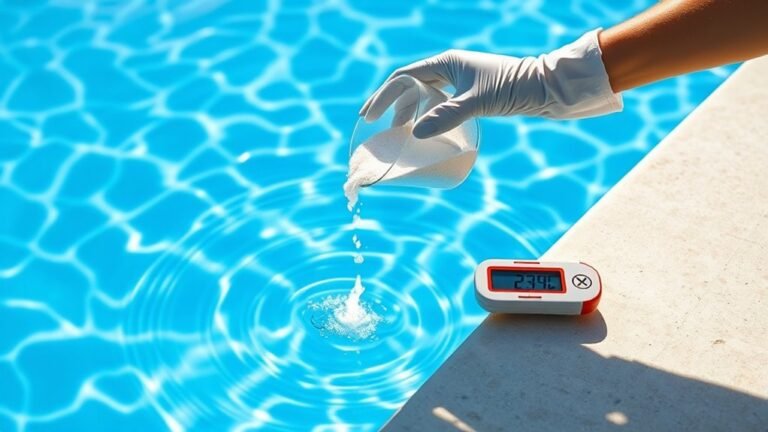
You can quickly lower your pool’s pH by adding muriatic acid while your pump runs to circulate the chemical evenly. Always wear gloves and goggles for safety.
Measure your current pH to calculate the right acid amount, then pour it slowly into the deep end. Retest after about 30 minutes and adjust if needed.
For ongoing balance and other chemical options, there are practical tips and alternatives to keep your pool water comfortable and clear.

You decide to wear underwear under swim trunks based on comfort, support, and trunk design. If your swim trunks lack a built-in lining or you want extra support during active water sports, adding quick-drying, seamless underwear can help prevent chafing and provide modesty.
However, wearing underwear might cause moisture buildup or restrict movement. Considering fabric, fit, and the activity you’ll do will guide your choice. Keep exploring to find what suits your swimwear needs best.