How Many Swimming Laps Equal One Mile
You’ll swim about 35 laps (down-and-back counts) in a 25-yard pool to cover one mile, since a mile equals 1,760 yards. Understanding how many swimming laps equal one mile depends on the pool size you’re using. This knowledge is essential for planning your workouts effectively.
In a 25-meter pool, it takes roughly 65 lengths to swim a mile, while in a 50-meter Olympic pool, you only need about 32 lengths. Pool length directly affects how many laps you need, so knowing this helps you set realistic goals and track your progress accurately.
Keep going to find tips on tracking distance and adjusting your swim for the best results. Whether you’re training for fitness or competition, mastering these details will improve your swimming experience.
Understanding Pool Lengths and Their Impact on Distance
How does the length of a swimming pool affect the number of laps you need to swim to complete a mile?
The longer the pool, the fewer laps you’ll have to swim to reach a mile. If the pool is shorter, you’ll swim more laps because each lap covers less distance.
For example, if the pool length doubles, the number of laps needed halves.
When you know the pool’s length, you can calculate the exact number of laps by dividing a mile (5,280 feet) by twice the pool length, since a lap counts as down and back.
Understanding this relationship helps you plan your swim workouts efficiently, so you can track your distance accurately without guessing or overestimating your effort.
Standard Pool Sizes Used in Swimming
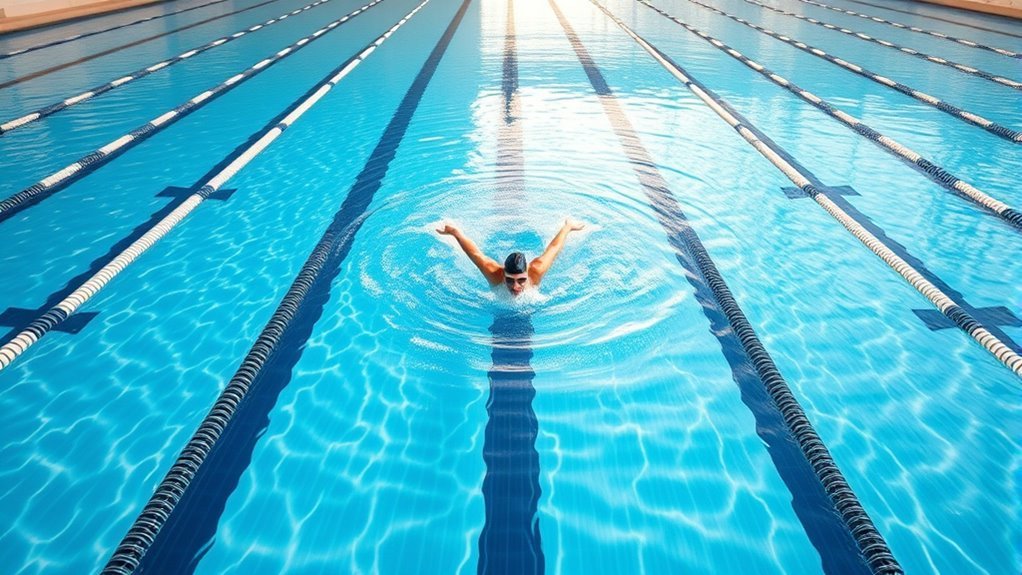
Knowing the length of the pool you’re swimming in sets the stage for understanding how many laps make up a mile. Standard pool sizes vary, but the most common ones are 25 yards, 25 meters, and 50 meters.
Understanding pool length is key to calculating how many laps equal a mile.
If you’re swimming in a short course pool, it’s likely 25 yards or 25 meters long. These are popular for training and competitions.
On the other hand, Olympic-sized pools measure 50 meters, giving you longer distances per lap.
Some pools may also be 33 1/3 yards, though they’re less common.
Calculating Laps in a 25-Yard Pool for One Mile
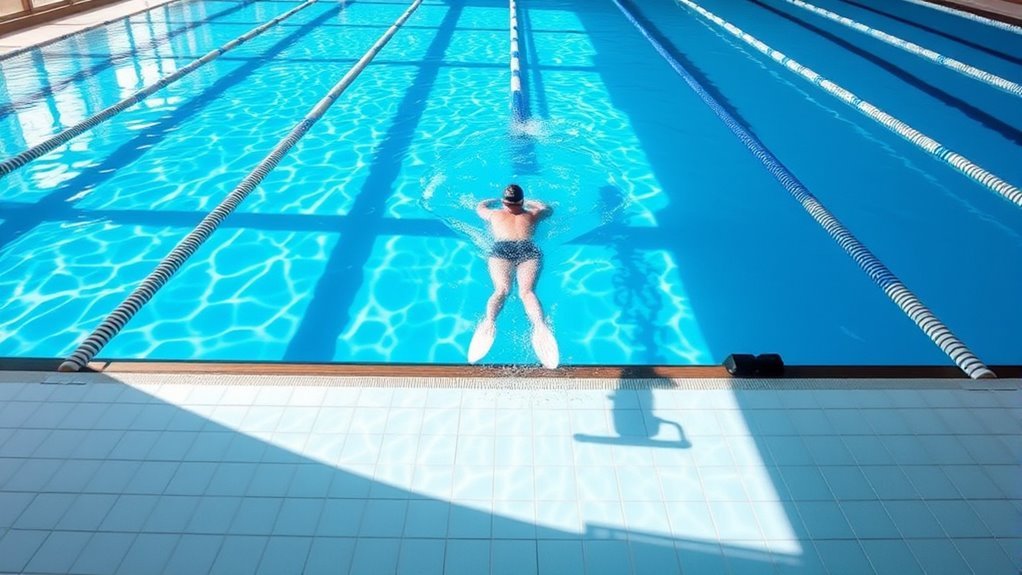
Since a mile equals 1,760 yards, you can determine the number of laps needed in a 25-yard pool by dividing this distance by the pool length. Divide 1,760 by 25, and you get 70.4.
This means you’ll need to swim about 70 full laps plus a little extra to reach a mile.
Since most pools measure laps as one length of the pool, you might prefer to count laps as down-and-back lengths, which doubles the distance. In that case, you’d swim 35 laps (there and back) to cover one mile.
Keep in mind, exact distances can vary slightly due to pool size tolerances, but 70 lengths or 35 laps is a reliable estimate for swimming a mile in a 25-yard pool.
Calculating Laps in a 25-Meter Pool for One Mile
Although a mile measures 1,609.34 meters, you’ll need to adjust your lap count when swimming in a 25-meter pool. Since each lap covers 25 meters, you’ll swim multiple laps to complete one mile.
To find the exact number, divide 1,609.34 by 25, which equals approximately 64.37 laps. Since you can’t swim a fraction of a lap, round up to 65 laps to cover one mile.
| Distance (meters) | Laps (25-meter pool) | Approximate Miles |
|---|---|---|
| 25 | 1 | 0.0155 |
| 100 | 4 | 0.0621 |
| 400 | 16 | 0.2485 |
| 1,609.34 | 65 | 1 |
Now, you know exactly how many laps make a mile in a 25-meter pool.
Calculating Laps in a 50-Meter Olympic Pool for One Mile
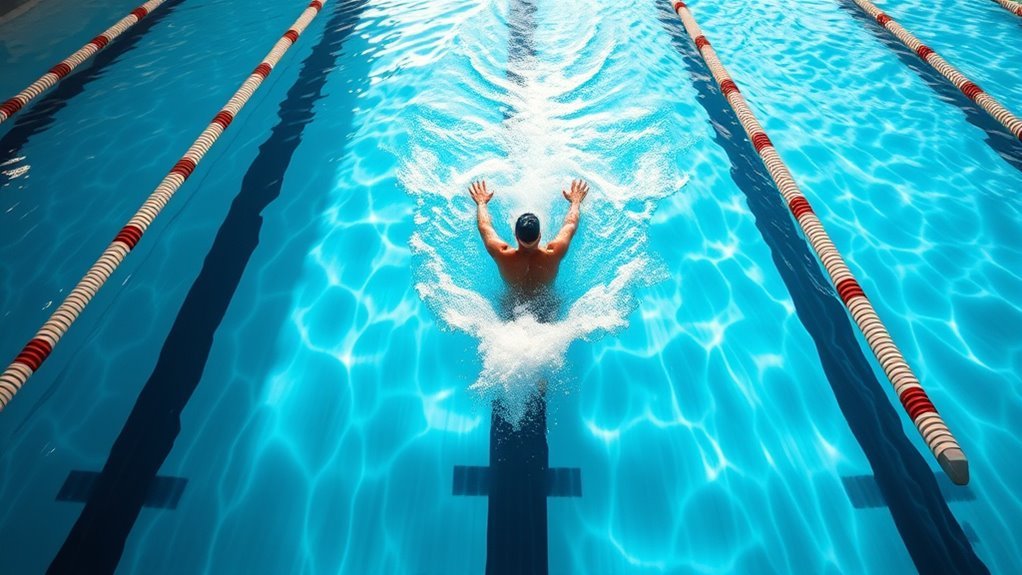
When you swim in a 50-meter Olympic pool, calculating how many laps equal one mile becomes simpler because each lap covers twice the distance of a 25-meter pool.
Since one mile equals 1,609 meters, you’ll need to swim approximately 32 lengths (or 16 laps) in a 50-meter pool to cover that distance. This makes tracking your progress straightforward and efficient.
Keep in mind:
- Each lap equals 100 meters (two lengths).
- Swimming 16 laps equals roughly one mile.
- Using a 50-meter pool reduces the number of turns, which can affect your pacing.
How Stroke Type Influences Swimming Distance and Speed
Because each swimming stroke uses different muscle groups and techniques, your speed and the distance you cover per lap can vary considerably.
For example, freestyle typically allows you to swim faster and cover more distance per stroke due to its streamlined body position and efficient arm movements.
Breaststroke, on the other hand, tends to be slower because of its wider arm pulls and the need to coordinate a frog-like kick.
Butterfly requires powerful bursts but can tire you quickly, affecting your pace over longer distances.
Backstroke offers moderate speed but demands strong core stability to maintain form.
Understanding how each stroke influences your speed helps you plan how many laps you need to swim to reach a mile, tailoring your training to your preferred stroke or mix for ideal performance.
Tips for Tracking Your Swimming Distance Accurately
Knowing how your stroke affects speed and distance is just one part of swimming efficiently. To track your swimming distance accurately, you need a reliable method that fits your routine. Start by familiarizing yourself with your pool’s length and counting each lap carefully.
Use visual cues like wall tiles or lane markings to avoid losing track.
Here are some tips to help you keep an accurate count:
- Count every length, not just laps (a lap is two lengths).
- Take breaks only after logging your distance to prevent errors.
- Use a waterproof notebook or mental tally to record laps mid-swim.
Using Technology to Measure Swimming Distance
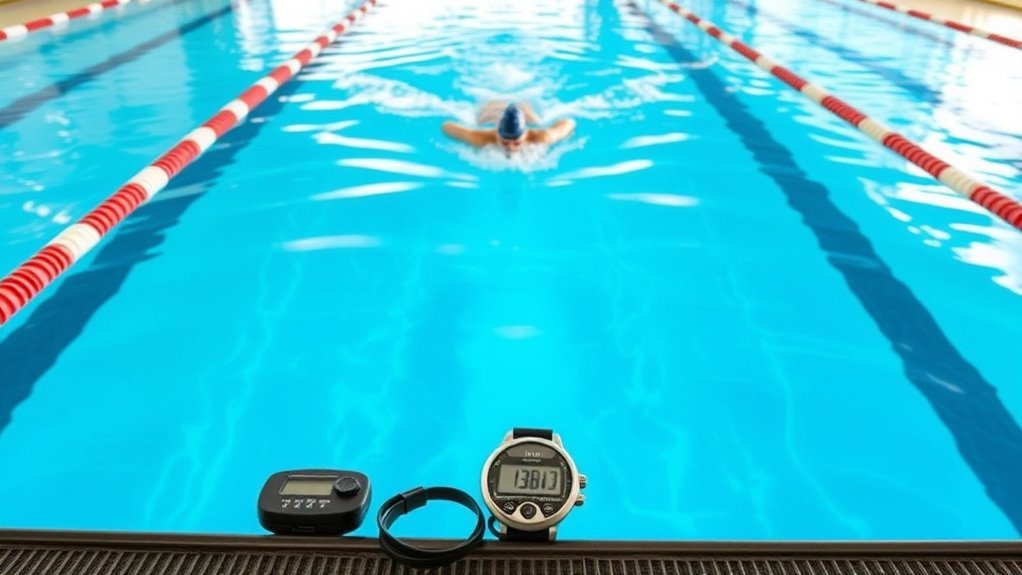
Although traditional methods like counting laps work well, technology can make measuring your swimming distance easier and more accurate. Using devices like waterproof fitness trackers or swim-specific smartwatches, you can automatically track laps, distance, and even stroke count without interrupting your workout.
Some apps sync with these devices to provide detailed summaries and progress reports. Here’s a quick comparison:
| Device Type | Features |
|---|---|
| Waterproof Fitness Tracker | Auto lap counting, distance tracking |
| Swim Smartwatch | Stroke analysis, GPS (open water) |
| Swimming Apps | Sync data, detailed session logs |
| Pool Sensors | Precise lap monitoring, real-time feedback |
These tools help you focus more on your swim and less on manual tracking.
Benefits of Knowing Your Swimming Distance
When you track your swimming distance, you can set clear goals and monitor your progress more effectively. Knowing how far you swim helps you stay motivated and committed to your routine. It also allows you to measure improvements in endurance and speed over time.
Plus, understanding your distance helps you plan workouts that match your fitness level.
Here are some key benefits of knowing your swimming distance:
- Improved goal setting: You can tailor your workouts to hit specific targets.
- Better progress tracking: You’ll see tangible results and stay motivated.
- Enhanced workout efficiency: You can balance intensity and recovery for ideal performance.
Adjusting Your Workout Based on Distance Goals
If you want to improve your swimming performance, adjusting your workout based on your distance goals is essential.
For shorter distances, focus on speed and power by incorporating interval training with bursts of high intensity followed by rest.
If you’re aiming to swim longer distances, prioritize endurance by swimming steady, continuous laps at a moderate pace.
You can also mix both approaches by including tempo sets that maintain a challenging pace without burning out.
Tracking your lap count and timing helps you tailor workouts to your goals and measure progress accurately.
Frequently Asked Questions
How Does Water Temperature Affect Swimming Performance?
Water temperature affects your swimming performance by impacting muscle function and endurance. Cold water can slow you down and increase fatigue, while warmer water helps your muscles stay flexible and boosts overall comfort and speed.
When the water is too cold, your muscles may tighten, reducing your efficiency and increasing the risk of cramps. On the other hand, warmer water promotes better circulation and muscle relaxation, which can enhance your swimming technique and stamina.
What Are the Best Breathing Techniques for Long-Distance Swimming?
Breathe like the ocean’s tide—steady and deep. Inhale through your mouth as your head turns, exhale fully underwater through your nose or mouth.
Keep a rhythmic pattern, like a metronome, to conserve energy and stay calm.
How Can I Improve My Swimming Endurance?
You can improve your swimming endurance by gradually increasing your distance, incorporating interval training, focusing on proper breathing techniques, and maintaining a consistent pace.
Additionally, cross-training with strength exercises can help build overall stamina and muscle endurance. This combined approach will enhance your swimming performance over time.
What Nutrition Is Recommended Before a Swimming Workout?
You should eat a light meal with carbohydrates and some protein about 1-2 hours before swimming. Avoid heavy fats and fiber to prevent discomfort, and stay hydrated by drinking water or an electrolyte drink.
How Often Should I Rest Between Swimming Sessions?
You should rest at least 24 hours between intense swimming sessions to let your muscles recover.
Surprisingly, 60% of swimmers report improved performance after proper rest, so don’t skip those recovery days—they really boost your progress!
Conclusion
You might worry that counting laps feels complicated, but once you know your pool’s length, it’s simple to track your progress. Whether you’re swimming in yards or meters, understanding how many laps equal a mile helps you set clear goals and measure improvements.
With just a little practice or a swim-tracking device, you’ll confidently hit your distance targets and make every swim count toward your fitness journey. Knowing how many swimming laps equal one mile is key to staying motivated and achieving your swimming goals.