How Fast Can a Sea Turtle Swim?
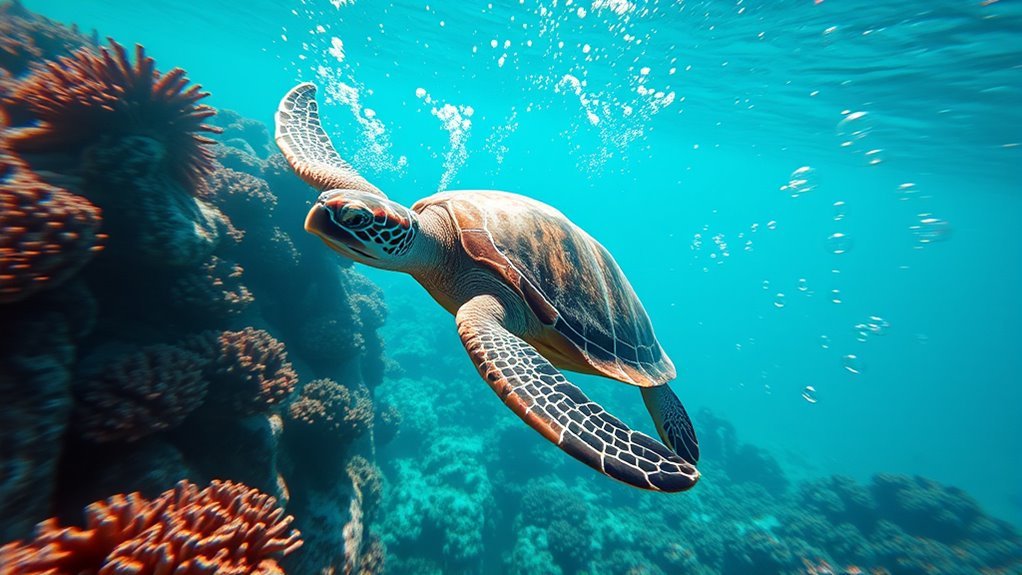
You’ll find most sea turtles swim steadily at about 1 to 2 miles per hour, cruising efficiently over long distances. When they need a burst of speed, some species like the leatherback can hit up to 22 mph for short sprints.
They use their large, paddle-shaped flippers for powerful thrust and precise steering. Many factors like species, size, and water conditions affect their speed.
Keep exploring to discover how their speed helps them migrate and escape predators.
Overview of Sea Turtle Species
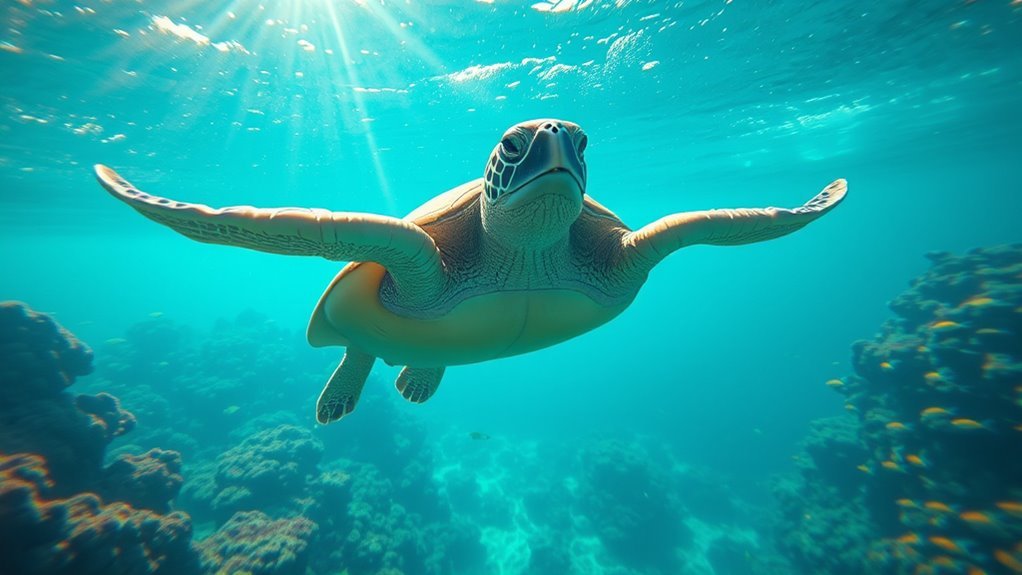
Although you mightn’t realize it, sea turtles come in seven distinct species, each with unique characteristics. You’ll find the green sea turtle, known for its herbivorous diet and rounded shell, and the leatherback, the largest species with a flexible, leathery shell.
Sea turtles boast seven unique species, from the herbivorous green to the massive, leathery leatherback.
The hawksbill stands out with its sharp, pointed beak, perfect for reaching sponges in coral reefs. Loggerheads have massive heads and powerful jaws, while olive ridleys are the smallest, famous for mass nesting events called arribadas.
Kemp’s ridley is critically endangered and nests primarily in the Gulf of Mexico. Finally, the flatback has a flatter shell and is native to Australian waters.
Understanding these species helps you appreciate the diversity among sea turtles before exploring their swimming abilities.
Average Swimming Speeds of Sea Turtles
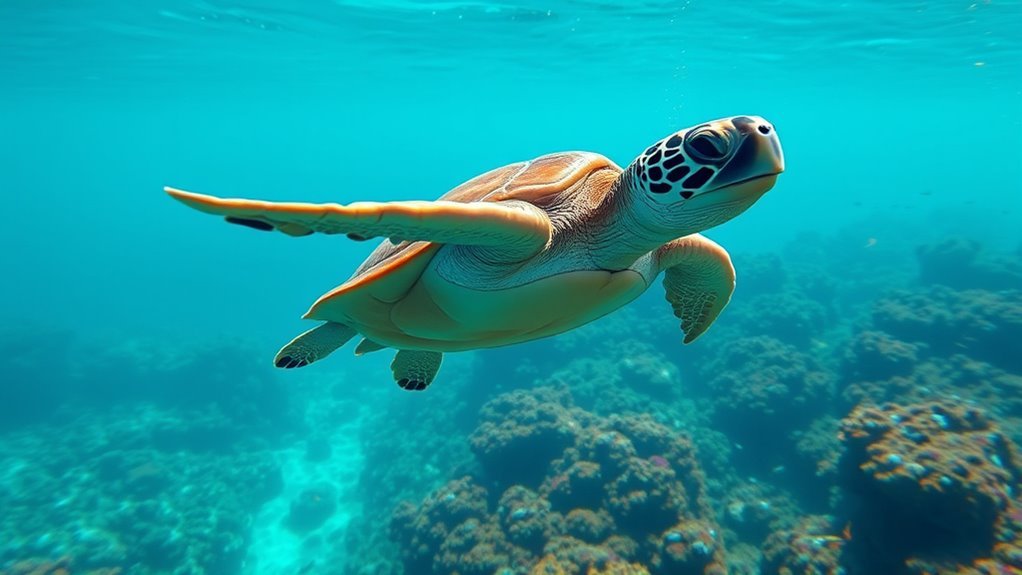
While sea turtles aren’t the fastest swimmers in the ocean, they can maintain steady speeds that help them travel long distances. Typically, you’ll find that most sea turtles cruise at around 1 to 2 miles per hour (1.6 to 3.2 kilometers per hour) during regular swimming.
This pace allows them to conserve energy while migrating between feeding grounds, nesting beaches, and open ocean habitats. When you observe them swimming, you’ll notice a smooth, deliberate stroke pattern, which supports their endurance rather than bursts of speed.
Although they can swim faster in short bursts, their average speeds reflect a balance between efficient movement and energy conservation. Understanding these average speeds gives you insight into how sea turtles navigate vast oceanic distances with remarkable persistence.
Fastest Sea Turtle Species Recorded
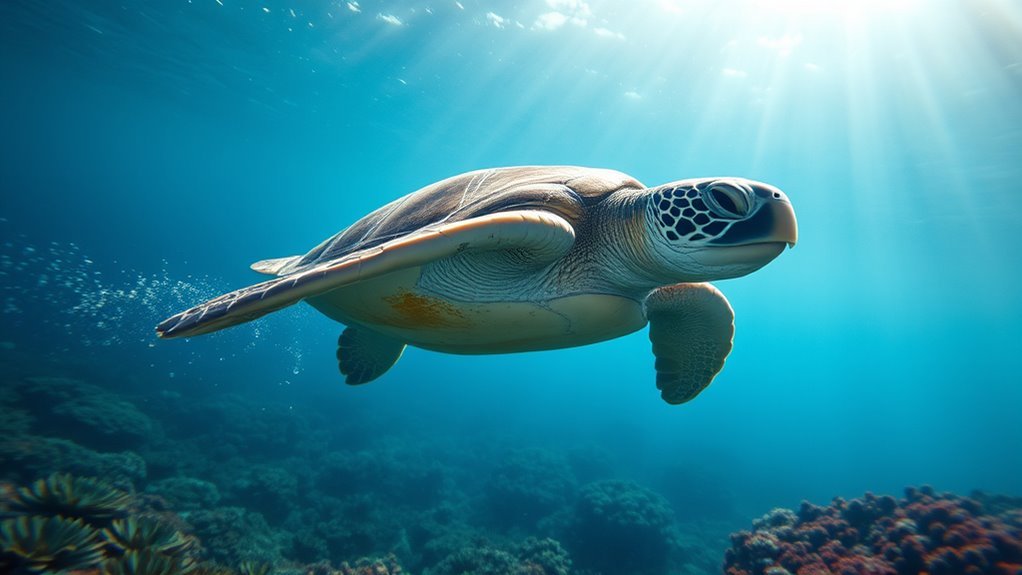
You might be curious which sea turtle holds the title for the fastest swimmer. The leatherback sea turtle tops the list, reaching speeds up to 22 miles per hour in short bursts.
Here’s a quick look at some of the fastest species recorded:
- Leatherback Sea Turtle: Up to 22 mph
- Green Sea Turtle: Around 20 mph in bursts
- Hawksbill Sea Turtle: Speeds near 15 mph
- Loggerhead Sea Turtle: Can hit about 17 mph
- Olive Ridley Sea Turtle: Roughly 14 mph
Knowing this, you can appreciate how these turtles use their speed to evade predators and travel long distances. The leatherback, with its powerful flippers and streamlined body, is especially built for fast swimming.
How Sea Turtles Use Their Flippers for Swimming
Since sea turtles rely on swimming to navigate vast oceans, their flippers play a crucial role in their movement and speed. When you watch a sea turtle, you’ll notice it uses its powerful front flippers much like wings, generating thrust to propel itself forward.
Sea turtles use their strong front flippers like wings to powerfully propel themselves through the ocean.
The large, paddle-shaped flippers provide strong, efficient strokes, allowing the turtle to glide smoothly through the water. Meanwhile, the smaller rear flippers act as rudders, helping with steering and balance.
You can think of their swimming style as a combination of flying underwater and rowing, which gives them both speed and maneuverability.
Understanding how they use their flippers helps you appreciate the sea turtle’s ability to travel long distances and adapt to different ocean currents.
Factors Influencing Sea Turtle Swimming Speed
Although sea turtles have natural swimming abilities, several factors influence how fast they can move through the water. When you’re watching a sea turtle glide, remember their speed isn’t constant. It depends on various elements.
You’ll notice that their physical condition, the water temperature, and even their motivation can change how quickly they swim.
Here’s what affects their speed:
- Species differences: Some species are built for speed, others for endurance.
- Age and size: Younger turtles may swim faster, but bigger ones have more power.
- Water currents: Strong currents can either help or hinder their progress.
- Temperature: Warmer water boosts muscle activity, increasing speed.
- Purpose: Swimming to escape predators or migrate makes turtles swim faster than when they’re just cruising.
Comparison With Other Marine Animals
How fast do sea turtles swim compared to other marine animals? While sea turtles cruise at around 1.5 to 2.5 mph, some marine creatures are speed demons, and others move more leisurely. You’ll see that their speeds vary widely depending on species and lifestyle.
| Animal | Average Speed (mph) | Top Speed (mph) |
|---|---|---|
| Sea Turtle | 1.5 – 2.5 | 22 |
| Dolphin | 5 – 12 | 25 |
| Great White Shark | 5 – 15 | 25 |
| Manta Ray | 3 – 7 | 22 |
| Blue Whale | 3 – 5 | 20 |
Sea turtles aren’t the fastest but can hold steady speeds for long periods, perfect for migration.
The Role of Speed in Sea Turtle Migration
When sea turtles begin their long migrations, their swimming speed plays a crucial role in reaching distant nesting or feeding grounds efficiently. You’ll find that maintaining a steady pace helps them conserve energy over thousands of miles.
Speed impacts how quickly they can:
- Navigate ocean currents effectively
- Avoid exhaustion during lengthy journeys
- Time their arrival to coincide with ideal environmental conditions
- Minimize exposure to harsh weather or unfavorable waters
- Reach breeding sites to ensure reproductive success
How Sea Turtles Evade Predators Through Speed
Speed doesn’t just help sea turtles cover vast distances; it also plays a vital part in keeping them safe from predators. When you imagine a sea turtle escaping a shark or a large fish, you might picture slow, steady swimming.
But in reality, sea turtles can burst into surprisingly quick sprints to evade danger. Their powerful flippers propel them forward rapidly, allowing you to see them dart away from threats in the blink of an eye.
This sudden acceleration can confuse predators, giving turtles the vital seconds they need to find shelter or dive deeper.
Technological Methods for Measuring Sea Turtle Speed
Although sea turtles move gracefully through water, measuring their exact swimming speed requires advanced technology. You can’t just watch and guess; scientists use specialized tools to gather accurate data.
If you want to understand how researchers track sea turtle speed, consider these methods:
Satellite Telemetry: Attaches transmitters to turtles, sending location data to satellites.
Accelerometers: Measure movement and acceleration in real-time.
Time-Lapse Photography: Captures sequences to calculate speed visually.
Underwater Drones: Follow turtles closely without disturbing them.
Acoustic Tags: Emit signals detected by underwater receivers to track movement.
Using these technologies, you get precise insights into how fast sea turtles swim, helping us learn more about their behavior and conservation needs.
Frequently Asked Questions
How Long Do Sea Turtles Live in the Wild?
You can expect sea turtles to live around 50 years or more in the wild. Some species, like the green sea turtle, might even reach 80 years if they avoid predators and human threats.
What Do Sea Turtles Eat?
You eat sea turtles feast on jellyfish, seaweed, and crustaceans, like a gardener tending various plants. They adapt their diet based on species and habitat, making sure they get the nutrients they need to thrive.
How Do Sea Turtles Find Their Way Back to Nesting Beaches?
You can rely on sea turtles’ incredible magnetic sense; they detect Earth’s magnetic fields to navigate back to nesting beaches. They also use the sun and ocean currents to guide their journey accurately across vast distances.
What Are the Main Threats to Sea Turtle Populations?
Imagine dark nets dragging beneath waves. Those, along with habitat loss, pollution, and climate change, threaten sea turtles. You can’t ignore these dangers if you want to protect their fragile populations from disappearing forever.
How Can Humans Help Protect Sea Turtles?
You can help protect sea turtles by reducing plastic use, supporting conservation programs, avoiding disturbing nesting sites, and advocating for marine protected areas.
Your actions make a big difference in preserving these amazing creatures.
Conclusion
You might be surprised to learn that some sea turtles can swim up to 35 miles per hour in short bursts! This incredible speed helps them escape predators and navigate vast oceans during migration.
Understanding how they use their powerful flippers and what affects their swimming pace gives you a deeper appreciation for these ancient mariners.
Next time you think about sea turtles, remember—they’re not just slow movers but surprisingly swift swimmers. Sea turtles swimming speed truly showcases their remarkable adaptability in the ocean.