How Many Yards Are in a Mile for Swimming?
You’ll find that one mile equals exactly 1,760 yards, which is important to know for swimming distances. Since pools in the U.S. often use yards, understanding this helps you track your swims accurately. Yard-based pools are typically 25 yards long, making mile conversions straightforward for training and competitions.
Because yards differ slightly from meters used elsewhere, knowing this helps you compare times and performance. If you want to improve your swim routine or race strategy, exploring these details can definitely help.
Understanding the Mile Measurement
Although you might think a mile is straightforward, its exact length can vary depending on the context. In everyday use, a mile is typically 5,280 feet. This standard, known as the statute mile, is what you’ll encounter on road signs or maps.
A mile seems simple, but its length varies by context—commonly 5,280 feet in everyday use.
However, there’s also the nautical mile, used in marine and air navigation, measuring about 6,076 feet.
Since swimming pools don’t use feet for measurement, understanding how yards relate to miles becomes essential.
One mile equals 1,760 yards because each yard contains three feet.
Knowing this helps you convert distances in swimming, where yards are the preferred unit.
Defining a Yard in Swimming

How exactly is a yard defined in the context of swimming? In swimming, a yard is a standardized unit of length used to measure pool distances, especially in the United States. One yard equals exactly 36 inches or 3 feet.
Pools designed for competitive swimming often use yard measurements to align with event standards.
Here’s a quick reference to help you understand the yard in swimming:
| Measurement Aspect | Yard Equivalent |
|---|---|
| Inches | 36 inches |
| Feet | 3 feet |
| Meters | 0.9144 meters |
| Pool Lengths (short) | Typically 25 yards |
| Common Use | U.S. competitive pools |
Knowing this helps you grasp how distances in swimming are structured and measured.
Converting Miles to Yards: The Exact Number
When you want to convert miles to yards, you need to know the exact relationship between these units. One mile equals 1,760 yards. This conversion is based on the standard definitions of these measurements where one yard is 3 feet and one mile is 5,280 feet.
To convert miles to yards, multiply the number of miles by 1,760. For example, if you’re swimming 2 miles, you’ll cover 3,520 yards.
This precise number helps you track distances accurately, especially during training or competitions.
Understanding this conversion guarantees you can set clear goals and compare your performance consistently, whether you’re measuring your swim in miles or yards.
Why Yards Are Used in Swimming Pools
Since swimming pools in the United States often follow specific standards, yards have become the preferred unit of measurement. When you swim in a pool measured in yards, you’re part of a tradition that prioritizes uniformity and ease.
Yards simplify pool design, timing, and competition rules.
Here’s why yards are commonly used:
Standardization: Pools built to yard specifications ensure consistent race lengths across venues.
Convenience: Yards align with the imperial system, which is still widely used in the U.S., making measurements easier to understand and communicate.
Competition: Many American swim meets and records use yards, so pools adopt this measurement to match official standards.
Comparing Yards and Meters in Swimming
Although yards are common in U.S. pools, meters dominate international swimming competitions, so understanding the differences between these measurements matters if you want to compare times or train effectively.
A yard equals 0.9144 meters, making a 25-yard pool slightly shorter than a 25-meter pool.
This difference affects your lap count and overall distance swum. For example, swimming 40 laps in a 25-yard pool covers less distance than 40 laps in a 25-meter pool.
When comparing times or setting goals, you need to convert distances accurately to avoid misleading results.
Using conversion factors helps you translate your yard-based times into metric equivalents, ensuring your training aligns with international standards and improving your performance tracking across different pool sizes.
How Pool Length Affects Distance Tracking
Because pool lengths vary, you need to track your distance carefully to make certain your swim workouts and goals stay accurate.
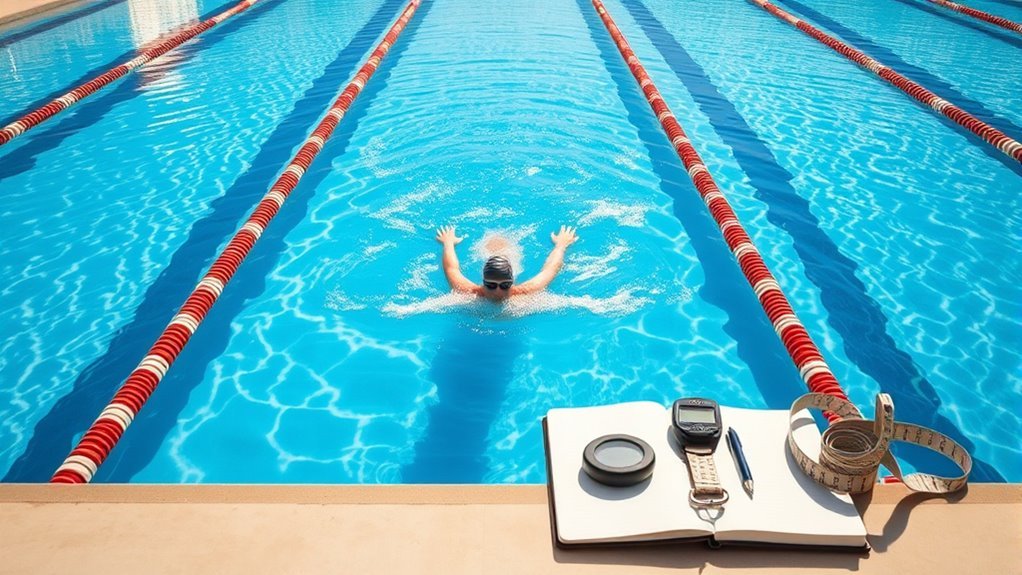
Pools come in different sizes: 25 yards, 25 meters, or 50 meters. Each affects how you count laps and total distance.
Pool lengths vary—25 yards, 25 meters, or 50 meters—impacting lap counts and total swim distance.
Misunderstanding your pool length can lead to errors in tracking progress or meeting distance goals.
Keep these points in mind:
- Know your pool’s exact length before starting.
- Convert pool length units to match your training goals (yards vs. meters).
- Count laps precisely, considering turns and pool size.
Calculating Swim Distances for Training
When you calculate swim distances for training, you’ll need to convert your laps into consistent units that match your goals.
For example, if you swim in a 25-yard pool and want to track mileage, remember that one mile equals 1,760 yards.
Counting your laps and multiplying by 25 gives you the total yards swum. Dividing that number by 1,760 converts your distance into miles.
This method helps you set clear targets and measure progress accurately.
If your pool measures 50 meters, convert meters to yards first (1 meter ≈ 1.094 yards) before calculating miles.
Keeping your units consistent prevents confusion and ensures your training aligns with distance goals, making it easier to plan workouts and monitor improvements effectively.
Impact of Distance Conversion on Competition Times
How do distance conversions affect your competition times? When you switch between yards and miles, the exact distance changes, impacting your pacing and overall performance. If you’re not careful, you might misjudge your effort, leading to slower times or early fatigue during races.
Here’s what you should keep in mind:
- Pacing Adjustments: A mile in yards (1760 yards) differs from metric distances, so you need to adjust your splits accordingly.
- Time Comparisons: Comparing times across distances without conversion can give you inaccurate performance assessments.
- Training Specificity: Training in the exact race distance or converting distances precisely is key to predicting your competition times accurately.
Understanding these impacts ensures you prepare smarter and race stronger.
Tips for Tracking Progress Across Different Pool Sizes
Tracking your progress across different pool sizes can be challenging, but it’s essential for accurate assessment and improvement. First, convert your distances into a common unit, like yards or meters, to compare times effectively. Use conversion charts or apps to handle this quickly.
Next, record your splits consistently, noting pool length and stroke type. This helps you spot patterns and areas needing work. Also, consider the impact of turns and push-offs; shorter pools mean more turns, which can affect your pace. Adjust your expectations accordingly.
Finally, set realistic goals based on the pool size you’re training in. By standardizing your tracking method and understanding pool differences, you’ll monitor your progress more accurately and stay motivated.
Frequently Asked Questions
How Does Swimming Speed Vary Between Yard and Meter Pools?
You’ll swim faster in yard pools since they’re shorter than meter pools. Fewer meters mean less distance per lap, so your speed looks quicker.
Plus, more turns in yards can boost your momentum and overall pace.
What Is the History Behind Using Yards in American Pools?
You’ll find yards in American pools because the U.S. historically used the imperial system. For example, the NCAA adopted 25-yard pools to fit existing gym spaces, making competitions convenient and consistent nationwide.
Are Swimwear Regulations Different for Yard vs. Meter Competitions?
Yes, swimwear regulations can differ between yard and meter competitions since governing bodies like USA Swimming and FINA have distinct rules. You’ll want to verify each event’s specific guidelines to ensure your suit complies.
How Do Electronic Timing Systems Adjust for Different Pool Lengths?
You know what they say, “Measure twice, cut once.” Electronic timing systems automatically adjust for pool lengths by calibrating lap distances and start/stop signals, ensuring your swim times are accurate whether the pool’s yards or meters.
Can Open Water Swimming Distances Be Measured in Yards?
You generally won’t see open water swimming distances measured in yards because those events use natural bodies of water. Instead, they’re almost always measured in meters or kilometers for consistency and international standards.
Conclusion
Now that you know there are exactly 1,760 yards in a mile for swimming, you’re ready to conquer any pool distance like a champion. Whether you’re training in yards or meters, understanding these conversions will make tracking your progress feel like a breeze instead of a marathon.
Don’t let pool lengths confuse you—use this knowledge to swim smarter, faster, and with confidence that your efforts are making waves bigger than the ocean itself!
Knowing how many yards are in a mile is essential for swimmers aiming to improve performance and measure distances accurately. Keep this key conversion in mind during your workouts to swim efficiently and achieve your goals.