How Many Yards Are in a Mile for Swimming?
You swim 1,760 yards to complete a mile in the pool. Understanding how many yards are in a mile for swimming helps you track your distance accurately, especially in pools measured in yards rather than meters. Since one mile equals 1,760 yards, knowing this conversion is essential for swimmers.
Pools use yards because measuring laps in miles would make the lengths impractical. This knowledge lets you set clear goals and compare distances easily during your training sessions.
If you want to improve your swimming or understand how yards relate to meters and miles, there’s more to explore. Knowing these conversions can help you optimize your workouts and track progress effectively.
Understanding the Basics of Distance Measurement in Swimming

Although you might be more familiar with miles in running or driving, swimming uses different units to measure distance. In swimming, distances are commonly measured in yards or meters, depending on where you swim.
Pools in the United States often use yards, while international competitions usually rely on meters.
Understanding these units helps you track your progress and compare times accurately. You’ll notice that swim workouts and races list distances in yards or meters rather than miles.
This measurement difference matters because pool lengths vary, affecting how you count laps and set goals.
Getting comfortable with yards in swimming sets the foundation for grasping how these distances relate to miles, which you’ll explore next.
Knowing this helps you become a smarter and more efficient swimmer.
The Exact Conversion: Yards to Miles
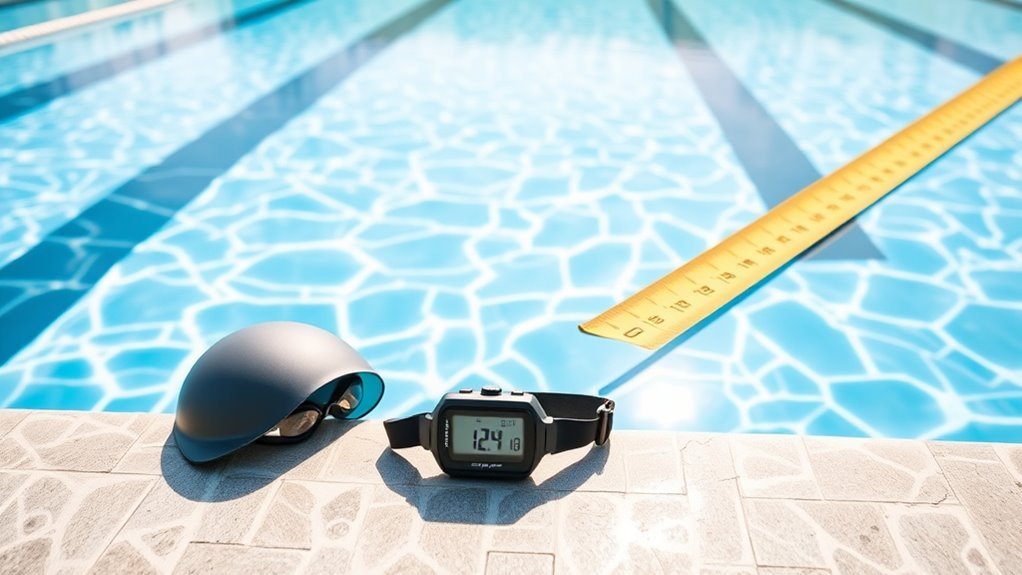
Now that you understand why swimming distances are measured in yards or meters, it’s helpful to know exactly how those units relate to miles. One mile equals 1,760 yards.
So, if you want to convert swimming distances from yards to miles, you just divide the number of yards by 1,760.
For example, if you swim 880 yards, you’ve covered exactly half a mile.
This conversion helps you track your progress more clearly, especially when comparing yard-based pool swims to open-water miles.
Knowing this exact conversion also lets you set goals and understand race lengths better.
Why Pools Are Measured in Yards Instead of Miles

Swimming pools are measured in yards instead of miles because yards offer a practical, manageable unit for designing and timing swims. If pools were measured in miles, the lengths would be too long and impractical for most swimming activities. You’d find it difficult to track progress or set meaningful goals during training.
Yards allow for standardized pool lengths, like 25 or 50 yards, which make timing and competition straightforward. Since swimming often involves short, repetitive laps, yards fit naturally into this structure.
Measuring in miles would complicate things by introducing unwieldy distances that don’t align with typical swim workouts or races.
Comparing Swimming Distances: Yards vs. Meters vs. Miles
Understanding why pools are measured in yards sets the stage for comparing how yards, meters, and miles relate to each other in swimming. When you swim, you’ll notice that most U.S. pools use yards, while international pools use meters.
A yard equals 0.9144 meters, so a 25-yard pool is slightly shorter than a 25-meter pool.
When considering miles, remember one mile equals 1,760 yards or about 1,609 meters. This means swimming a mile in yards requires you to complete more laps than in meters due to the shorter length.
Knowing these differences helps you better track your distances across various pools and competitions.
Whether you’re training or racing, understanding how yards, meters, and miles compare guarantees you stay accurate with your swimming goals.
How Knowing Yard-to-Mile Conversion Helps in Training
Since training often involves precise distance goals, knowing how to convert yards to miles lets you plan your workouts more effectively. When you understand that one mile equals 1,760 yards, you can easily break down your swim sets to match your target distances.
This clarity helps you track progress, set realistic goals, and avoid overtraining or undertraining. For example, if your workout calls for a two-mile swim, you know you need to cover 3,520 yards.
This conversion also helps you compare your performance across different pool lengths and training sessions. Overall, mastering yard-to-mile conversions sharpens your training strategy, ensuring every lap counts toward your endurance and speed improvements.
You stay focused and motivated by measuring your swim in familiar terms.
Common Swimming Events and Their Distances in Yards and Miles
Ever wondered how the distances in popular swim meets translate from yards to miles? Knowing this helps you grasp the challenge each event poses.
For example, a 500-yard freestyle is roughly 0.28 miles, while the 1650-yard freestyle, often called the “mile,” is just about 0.94 miles. Here’s a quick look at common events:
| Event | Distance (Yards) | Distance (Miles) |
|---|---|---|
| 100-yard freestyle | 100 | 0.057 |
| 500-yard freestyle | 500 | 0.28 |
| 1000-yard freestyle | 1000 | 0.57 |
| 1650-yard freestyle | 1650 | 0.94 |
Understanding these conversions lets you better plan your training and race strategies.
Tips for Tracking Your Swimming Progress Using Yards and Miles
When you track your swimming progress using yards and miles, you get a clear picture of how far you’ve improved over time. Start by setting specific distance goals in yards, like swimming 500 or 1,000 yards per session.
Tracking swimming in yards and miles helps you clearly see your progress and set achievable distance goals.
Convert these distances to miles to understand your overall weekly or monthly mileage. Use a waterproof watch or swimming app to log each workout, noting the total yards completed.
Review your logs regularly to spot trends and adjust your goals accordingly. Remember, consistency matters more than speed initially, so focus on building your distance steadily.
Tracking both yards and miles gives you flexibility to compare workouts easily and stay motivated as you see tangible progress in your swimming endurance and stamina.
Frequently Asked Questions
How Many Laps Equal One Mile in an Olympic Pool?
You’ll need to swim 32 laps in an Olympic pool to complete one mile. Each lap is 50 meters, so 32 laps total 1600 meters, which is very close to the mile distance of 1609 meters.
What Is the Average Time to Swim a Mile in Yards?
You’ll typically swim a mile in about 20 to 40 minutes, depending on your skill and fitness. Beginners take longer, while experienced swimmers can finish faster.
Keep practicing, and you’ll improve your time steadily!
Are Swimming Mile Records Measured in Yards or Meters?
Imagine a pool split by lane lines—swimming mile records are measured in meters internationally, while yards dominate U.S. pools.
You’ll find meters in Olympic pools and yards in many American competitions, blending tradition with global standards.
How Do Open Water Swimming Distances Compare to Pool Miles?
Open water swimming distances often use miles or kilometers, so you’ll swim a full mile or more in natural settings.
Pool miles are measured in yards or meters, so the experience and exact lengths can differ.
Can Swimming Workouts Be Planned Using Miles Instead of Yards?
Yes, you can plan swimming workouts using miles instead of yards. Just remember to convert miles to yards—one mile equals 1,760 yards—so your distances stay accurate and your training stays effective.
Conclusion
Now that you’ve dived into how yards translate to miles in swimming, you’re better equipped to navigate your workouts with confidence. While pools might not stretch out to a full mile, understanding these conversions gently lifts the veil on your progress, making each length feel more meaningful.
Embrace this knowledge as a subtle companion in your training journey, turning every lap into a quiet victory toward your goals. Keep swimming smart and steady! Knowing how many yards are in a mile for swimming adds clarity and purpose to your practice, helping you track your improvements effectively.