How Many Gallons Is My Swimming Pool in 10 Steps
To find out how many gallons your swimming pool holds, start by measuring its length, width, and average depth—making sure to account for both shallow and deep ends. These measurements are essential for calculating the pool’s volume accurately.
Next, calculate the volume by multiplying these dimensions together. Then, convert the volume from cubic feet to gallons by multiplying by 7.48, since one cubic foot equals approximately 7.48 gallons.
For round or irregularly shaped pools, use the appropriate formulas to find the volume. Don’t forget to adjust your calculations for additional features like steps or spas.
Finally, double-check your math to ensure accuracy. Keep following these steps, and you’ll discover the full method to get a precise measurement of your swimming pool’s capacity.
Measure the Length of Your Pool
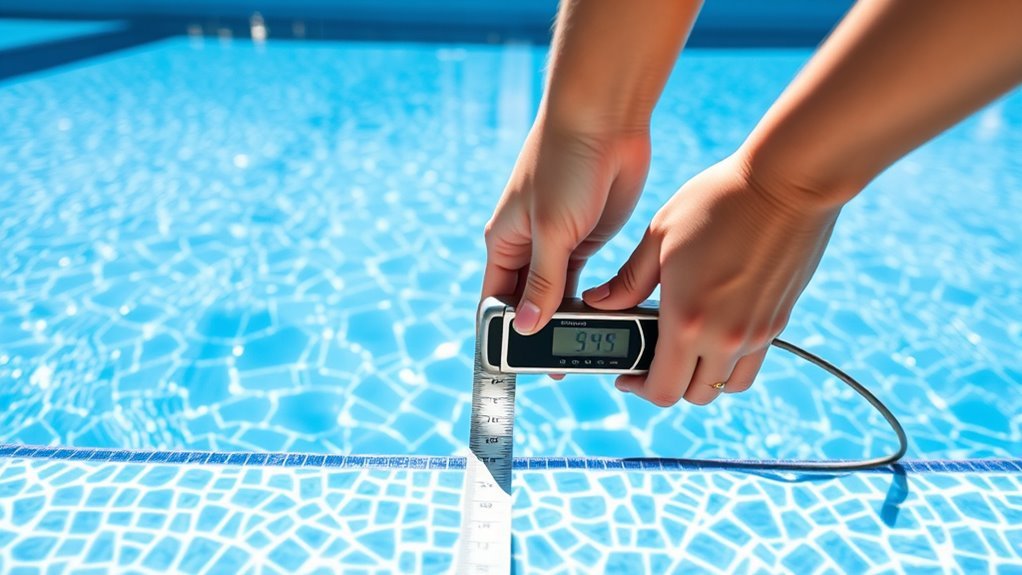
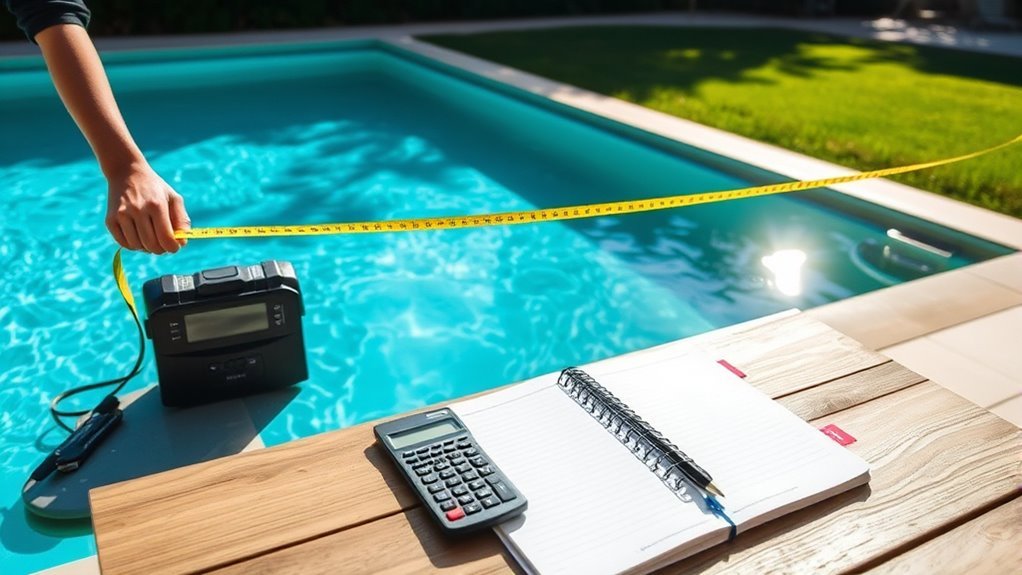
Before you can calculate your pool’s volume, you’ll need to measure its length accurately. Grab a tape measure or a long measuring tool and stretch it from one end of the pool to the other, following the pool’s longest straight edge.
Begin by measuring your pool’s length carefully, using a tape measure along the longest straight edge.
If your pool has a curved shape, measure along the centerline to get the most precise length.
Make sure the tape is taut and level, so you avoid any slack or sagging that could throw off your measurement.
Write down the length in feet or meters, depending on your preference or the units you’ll use later in calculations.
Taking your time here matters because an incorrect length can lead to a wrong volume estimate, affecting everything from chemical dosing to pool maintenance.
Measure the Width of Your Pool

How wide is your pool at its broadest point? To get an accurate measurement, use a tape measure or a long measuring stick. Stretch it straight across the pool from one edge to the other, making sure it stays level and doesn’t sag.
If your pool isn’t perfectly rectangular, measure the widest section you can find. For irregular shapes, take multiple width measurements at different points and note them down. This ensures you capture the true width instead of just a single spot.
Record the width in feet, as this will help you calculate the pool’s volume later. Being precise here is important because the width plays a key role in determining your pool’s overall capacity.
Determine the Average Depth of Your Pool

Since pool depth can vary, you’ll need to find the average depth to get an accurate volume estimate. This means measuring both the shallow and deep ends, then calculating their midpoint. Here’s how to do it:
Use a measuring tape or a weighted rope for accuracy. Measure from the pool floor to the water surface at the shallow end.
Repeat the measurement at the deepest point.
Add both depths together. Divide the sum by two to get the average depth.
Knowing the average depth helps you avoid overestimating or underestimating your pool’s volume.
Take your time with these measurements—they’re essential for the next step where you’ll calculate the total gallons your pool holds.
Calculate Volume for Rectangular and Square Pools
When you have the average depth, you can calculate the volume of rectangular or square pools by multiplying the length, width, and average depth. Measure the length and width in feet, then multiply these measurements by the average depth, also in feet, to get the volume in cubic feet.
Next, convert this volume into gallons by multiplying the cubic feet by 7.48, since one cubic foot holds 7.48 gallons of water.
For example, if your pool is 30 feet long, 15 feet wide, and has an average depth of 5 feet, multiply 30 × 15 × 5 to get 2,250 cubic feet.
Then multiply 2,250 by 7.48, resulting in 16,830 gallons.
This straightforward calculation gives you an accurate estimate of your pool’s water capacity.
Calculate Volume for Circular Pools
Although circular pools have a different shape from rectangular ones, you can still calculate their volume with a simple formula. To find the volume in gallons, you’ll need the pool’s diameter and average depth.
Here’s how to do it:
Follow these simple steps to calculate your circular pool’s volume accurately and easily.
Measure the diameter across the widest part of the pool.
Calculate the radius by dividing the diameter by 2.
Measure the average depth (shallow end + deep end, then divide by 2).
Use the formula: Volume (cubic feet) = π × radius² × average depth.
Convert cubic feet to gallons by multiplying the result by 7.48.
Calculate Volume for Oval Pools
If you want to find out how many gallons your oval pool holds, you’ll need to measure its length, width, and average depth. Use these measurements to calculate the volume using the formula:
Volume = Length × Width × Average Depth × 5.9 (where 5.9 converts cubic feet to gallons).
Here’s a quick way to organize your measurements:
| Measurement | Example Value (ft) |
|---|---|
| Length | 30 |
| Width | 15 |
| Average Depth | 5 |
| Volume (Gallons) | 30 × 15 × 5 × 5.9 = 13,275 |
Once you have these numbers, multiply them as shown to find out your pool’s capacity in gallons. This method works for any oval pool size!
Calculate Volume for Kidney-Shaped Pools
Because kidney-shaped pools have irregular curves, calculating their volume requires a slightly different approach than standard shapes. You’ll need to break the pool into simpler sections to estimate its total volume accurately.
Here’s how you can do it:
Measure the pool’s length and width at its widest points. Divide the pool into two overlapping circles or ovals. Calculate the area of each section separately.
Find the average depth by measuring at several points. Multiply the combined surface area by the average depth to get the volume in cubic feet.
This method helps you handle the unique shape without complicated formulas. Once you have the volume in cubic feet, you’re ready to move on to converting it into gallons.
Convert Cubic Feet to Gallons
How do you turn your pool’s volume from cubic feet into gallons? It’s simple: multiply the total cubic feet by 7.48. One cubic foot equals approximately 7.48 gallons of water.
So, if your kidney-shaped pool’s volume is 500 cubic feet, you multiply 500 by 7.48, giving you 3,740 gallons.
Make sure you’ve accurately calculated your pool’s volume in cubic feet before converting. Use the exact figure to get a precise gallon measurement.
This conversion helps you understand how much water your pool holds, which is essential for maintenance, chemical treatments, and filling.
Adjust for Pool Features and Accessories
While calculating your pool’s volume gives you a solid baseline, you’ll want to adjust for any features or accessories that affect water capacity. These can either add or subtract from the total gallons your pool holds.
Consider the following when refining your calculation:
Built-in spas or hot tubs: They add extra volume if filled separately.
Steps and benches: These reduce the water’s volume since they occupy space.
Diving boards or slides: They don’t change volume but can affect water displacement during use.
Pool covers: While they don’t impact capacity, they influence evaporation rates.
Attached waterfalls or fountains: They circulate water but don’t add volume.
Factoring these in ensures you get a more accurate estimate of your pool’s actual water capacity.
Verify Your Calculation for Accuracy
After adjusting for features and accessories, double-checking your pool volume calculation helps prevent costly errors. Start by reviewing your measurements to make sure you entered the correct length, width, and average depth.
Recalculate the volume using your chosen formula and compare it with your initial result. If you used online calculators, input your data again to verify consistency.
Also, confirm you accounted for all variations, like steps or irregular shapes.
Small mistakes in measurements or formulas can considerably affect the final gallon estimate. If possible, have someone else independently calculate the volume to catch any overlooked errors.
Taking these steps ensures your pool maintenance and chemical dosing are accurate, saving you time and money in the long run. Don’t rush this step; it’s essential for reliable results.
Frequently Asked Questions
How Often Should I Drain and Refill My Swimming Pool?
You should drain and refill your pool every 3 to 5 years, depending on water quality and chemical balance.
Regular maintenance and testing help decide the best timing to keep your pool clean and safe.
What Chemicals Are Needed to Maintain Pool Water Quality?
Think of chlorine as your pool’s sword, battling germs. You’ll also need pH balancers, algaecides, and stabilizers to keep water clear and safe.
Regular testing guarantees your watery kingdom stays pristine and inviting.
How Can I Reduce Water Evaporation From My Pool?
You can reduce water evaporation by using a pool cover, especially when the pool’s not in use. Also, reduce water temperature, minimize splash-out, and install windbreaks to block drying winds around your pool area.
What Is the Best Way to Heat My Swimming Pool?
The best way to heat your pool is by using a solar cover combined with a solar heater. This method saves energy, reduces evaporation, and efficiently warms your water, letting you enjoy comfortable swims longer.
How Do I Prevent Algae Growth in My Pool?
Picture crystal-clear water shimmering in sunlight; to prevent algae growth, you’ll keep your pool’s pH balanced, shock it regularly, maintain proper chlorine levels, clean filters often, and brush surfaces to stop algae from taking hold.
Conclusion
Now that you’ve uncovered your pool’s true size, you’re holding the key to open up endless summer fun. Knowing your pool’s gallons is like having the heartbeat of your watery oasis at your fingertips. With each calculation, you’ve painted a clearer picture of your personal paradise.
So plunge in with confidence—your pool isn’t just water; it’s a shimmering canvas ready for memories, laughter, and revitalizing escapes under the sun. Understanding how many gallons is my swimming pool empowers you to maintain perfect water balance and enjoy every splash to the fullest.