How Many Swimming Pool Laps Make a Mile?
How Many Swimming Pool Laps Make a Mile? This is a common question for swimmers aiming to track their distance accurately. You’ll need about 70 laps in a 25-yard pool, 64 laps in a 25-meter pool, or 33 laps in a 50-meter pool to swim a mile.
Each lap counts as one length of the pool, so knowing your pool’s exact size is key for accurate tracking. Using a swim watch or lap counter can help you stay on track. Keep going, and you’ll find useful tips to improve your swimming routine.
Understanding Pool Lengths and Their Impact
Although swimming pool lengths can vary, knowing the exact size of your pool is essential when calculating how many laps make a mile.
Pools come in standard lengths like 25 yards, 25 meters, or 50 meters, but some may be irregular.
Standard pool lengths include 25 yards, 25 meters, and 50 meters, though some pools vary.
When you know your pool’s length, you can convert miles into the number of laps you need to swim.
For example, a mile is 1,760 yards or 1,609 meters, so the pool length determines how many times you must swim up and back.
Even small differences in length affect your lap count.
Calculating Laps for a Mile in a 25-Yard Pool
Swimming a mile in a 25-yard pool requires you to complete 70.4 laps, or 35 full lengths, since a mile equals 1,760 yards.
To calculate this, simply divide the total yards in a mile by the pool length: 1,760 ÷ 25 = 70.4 laps.
Because you can’t swim a fraction of a lap practically, you’ll usually round this to 70 or 71 laps depending on your preference.
Keep in mind, each lap counts as one length of the pool, so 35 lengths equal a mile.
Tracking your laps accurately helps you measure your distance and pace effectively during training or workouts in a 25-yard pool.
This calculation guarantees you reach your mile goal every time you swim.
Calculating Laps for a Mile in a 25-Meter Pool
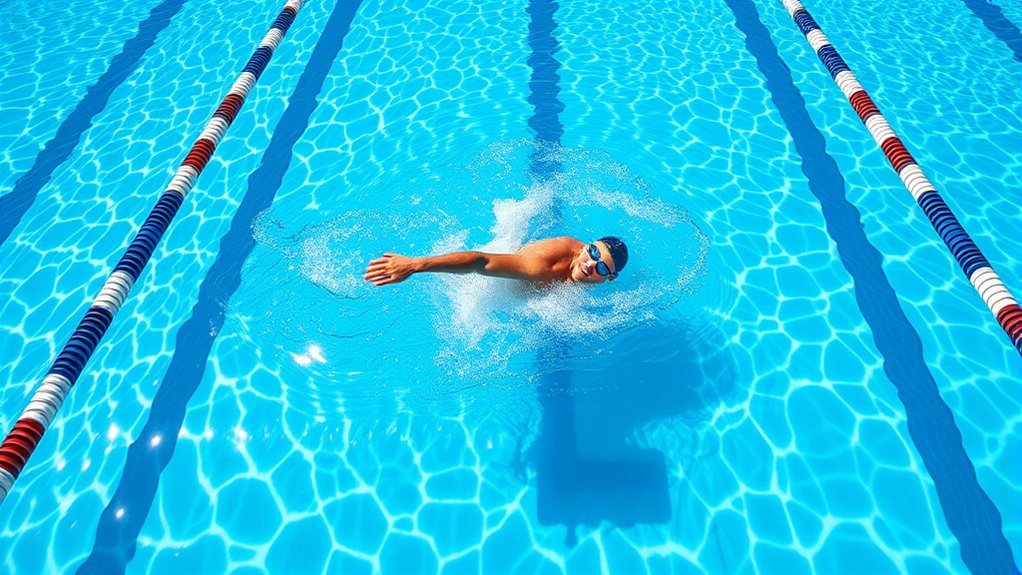
When you swim in a 25-meter pool, you’ll need to complete about 64 laps to cover a mile, since a mile is approximately 1,609 meters. Each lap equals one length of the pool, so counting laps helps you track your distance accurately.
| Laps Completed | Distance Covered (meters) | Distance Covered (miles) |
|---|---|---|
| 10 | 250 | 0.16 |
| 25 | 625 | 0.39 |
| 40 | 1,000 | 0.62 |
| 50 | 1,250 | 0.78 |
| 64 | 1,600 | 0.99 |
Using the table, you can easily plan your swim sets to reach a mile efficiently.
Calculating Laps for a Mile in a 50-Meter Pool
If you’re accustomed to swimming in a 25-meter pool, switching to a 50-meter pool means you’ll need to modify how you count your laps to cover a mile.
Since a mile is approximately 1,609 meters, you’ll want to calculate how many lengths of the pool equal that distance.
In a 50-meter pool, one lap is 50 meters, so you divide 1,609 by 50. This gives you about 32.18 laps.
Because you can’t swim a fraction of a lap, you’ll need to complete 33 laps to swim just over a mile.
Keep in mind, a lap here refers to one length, not a round trip.
This adjustment ensures you accurately track your distance when swimming in a longer pool.
Tips for Tracking Your Distance Accurately
Although tracking your swimming distance might seem straightforward, it requires consistent methods to stay accurate. First, always know your pool length and stick to swimming in the same lane to avoid confusion.
Use a waterproof swim watch or fitness tracker designed for swimming; these devices automatically count laps and measure distance. If you prefer manual tracking, keep a tally on a waterproof notepad or use a simple lap counter ring on your finger.
Reset your count at the start of each session to prevent errors. Pay attention to your turns and finishes. Missing one can throw off your total.
Finally, review your recorded data regularly to spot any inconsistencies and adjust your tracking method if needed. This way, you’ll ensure your distance measurements remain reliable every swim.
How to Use Lap Counts to Improve Your Swimming Routine
Since lap counts give you clear feedback on your progress, you can use them to set specific goals and monitor improvements in your swimming routine. Start by tracking your current lap counts per session, then gradually increase the number or speed.
Use lap counts to break your workout into manageable sets, helping maintain focus and endurance.
| Goal | Laps per Session |
|---|---|
| Beginner | 20 |
| Intermediate | 40 |
| Advanced | 60+ |
Frequently Asked Questions
What Are the Health Benefits of Swimming a Mile Regularly?
Swimming a mile regularly boosts your cardiovascular health, tones muscles, improves lung capacity, reduces stress, and enhances flexibility. You’ll also burn calories effectively while minimizing joint strain, making it a great full-body workout you can enjoy consistently.
How Long Does It Typically Take to Swim a Mile?
You’ll usually take 30 to 60 minutes to swim a mile, each stroke a steady heartbeat, each lap a wave’s whisper.
Your pace blends endurance and rhythm, turning distance into a flowing dance beneath the water’s surface.
What Swimming Strokes Burn the Most Calories per Mile?
You’ll burn the most calories per mile swimming butterfly and freestyle. Butterfly demands intense energy and muscle use, while freestyle lets you maintain a fast pace. Both strokes maximize calorie burn efficiently during your swim.
Can Swimming a Mile Help With Weight Loss?
Yes, swimming a mile can help you lose weight by burning calories and boosting your metabolism. If you swim consistently and combine it with a healthy diet, you’ll see results and improve your overall fitness.
How Should Beginners Train to Swim a Mile Efficiently?
You should start by swimming shorter distances, like 200-300 yards, gradually increasing. Since 60% of beginners improve endurance within six weeks, focus on consistent practice, proper breathing, and pacing to swim a mile efficiently over time.
Conclusion
Think of swimming laps like counting steps on a long hike—each lap brings you closer to your mile goal. Just like it takes about 70 laps in a 25-yard pool to cover a mile, every stroke counts toward your progress.
By tracking your laps accurately, you’re not just swimming—you’re building endurance and hitting milestones. So plunge in, keep count, and watch how each lap turns your swim into a powerful journey.
Understanding how many swimming pool laps make a mile helps you set clear targets and measure your fitness improvements effectively. Keep swimming, stay motivated, and enjoy the benefits of your consistent effort.