
How Many Swim Laps Are in a Mile?
You’ll swim about 70 laps in a 25-yard pool to cover a mile, since a mile is 1,760 yards. In a 25-meter pool, it takes roughly 65 laps, while a 50-meter Olympic pool requires about 33 laps to reach the mile mark. Pool size really affects how many laps you need, so knowing your pool length helps you plan workouts and track progress better.
Keep going if you want to find out how to set goals and measure your swim distance accurately.
Understanding Pool Lengths and Their Impact
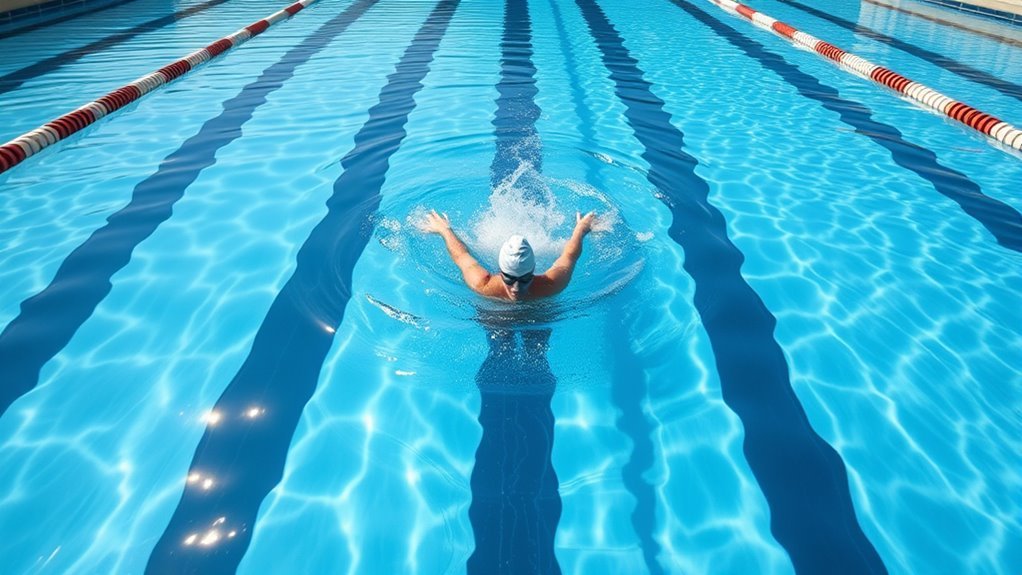
Although pool lengths vary, knowing their size is key to calculating how many swim laps make up a mile. Pools can be short course (25 yards or meters) or long course (50 meters), and each length affects your lap count differently.
When you swim in a 25-yard pool, you’ll cover less distance per lap than in a 50-meter pool. This means you’ll need to complete more laps to reach a mile.
If you swim in a meter pool, keep in mind that a mile equals approximately 1,609 meters, so your lap count will differ again.
Understanding these differences helps you plan your workouts effectively and track your progress accurately, no matter where you swim.
Calculating Laps in a Standard 25-Yard Pool

When you swim in a standard 25-yard pool, calculating how many laps equal a mile becomes straightforward once you know the distance per lap.
A mile is 1,760 yards, so you divide that by 25 yards per lap.
Doing the math, you get 70.4 laps. Since you can’t swim a fraction of a lap, you’ll round that to 70 or 71 laps depending on your goal.
Remember, a lap here means swimming from one end of the pool to the other, not a down-and-back.
If you’re tracking your distance, counting 70 laps will get you very close to a mile.
This helps you plan workouts and monitor progress accurately in a 25-yard pool.
Determining Laps in a 25-Meter Pool

Since a mile measures 1,609.34 meters, you can figure out how many laps you need to swim in a 25-meter pool by dividing that distance by 25.
When you do the math, 1,609.34 divided by 25 equals approximately 64.37.
That means you’ll swim about 64 laps to cover a mile in a 25-meter pool. Because you can’t swim a fraction of a lap, you’ll need to complete 65 laps to slightly exceed a mile.
Keep in mind, in swimming, one lap typically refers to swimming from one end of the pool to the other, so each lap covers 25 meters.
Knowing this helps you plan your sets and track your mileage accurately during training sessions in a 25-meter facility.
Swimming Laps in a 50-Meter Olympic Pool
Swimming in a 50-meter Olympic pool changes the calculation for how many laps you need to complete a mile. Since one mile equals 1,609 meters, you’ll swim fewer laps compared to a 25-meter pool.
In this larger pool, each lap covers twice the distance, so you adjust your count accordingly.
To swim one mile in a 50-meter pool, keep these key points in mind:
One lap equals 50 meters.
You need to swim 32.18 laps to cover a mile.
Practically, round to 32 or 33 laps.
Tracking laps helps maintain distance accuracy.
Knowing the lap count supports effective workout planning.
Understanding this helps you set realistic goals and measure your swimming progress precisely.
How Pool Size Affects Your Workout Distance
Although pool size might seem like a minor detail, it directly impacts how you measure and track your workout distance.
Different pools come in various lengths, 25 yards, 25 meters, or 50 meters, and this changes how many laps you need to swim to hit a mile.
For example, in a 25-yard pool, you’ll swim more laps than in a 50-meter pool to cover the same distance. If you switch pools often, you’ll have to adjust your lap count accordingly to stay accurate.
Knowing your pool’s exact length helps you plan workouts better and meet your distance goals without guesswork.
Always consider the pool size before setting your swim targets, so you can keep your training consistent and effective.
Tips for Tracking Distance While Swimming
When you want to track your swim distance accurately, using a reliable method can make all the difference. Keeping count manually can be tricky, so consider tools and techniques that fit your style.
Here are some tips to help you stay on top of your swimming distance:
Use a waterproof swim watch or fitness tracker with lap counting features.
Mark your progress on a waterproof notepad or sticky notes near the pool.
Break your swim into sets and record the number of laps per set.
Swim in a pool with marked distances, so you don’t have to guess.
Use smartphone apps designed for swimmers to log and analyze your workouts.
With these methods, you’ll get a clearer picture of how far you swim each session.
Setting Realistic Goals Based on Pool Size
Because pool sizes vary widely, setting achievable swim goals depends on understanding the length you’re working with.
If you swim in a standard 25-yard pool, you’ll need to complete 70.4 laps to cover a mile, but in a 25-meter pool, it’s about 64.4 laps.
For a 50-meter Olympic pool, only 32 laps equal a mile.
Knowing this helps you tailor your workouts realistically. Don’t aim for a mile if that means an overwhelming number of laps in a short pool; instead, set smaller distance goals that build your endurance gradually.
Tracking your progress becomes simpler when you measure in consistent units. Adjust your goals based on the pool size to stay motivated and avoid burnout while steadily improving your swimming stamina.
Frequently Asked Questions
What Swim Strokes Burn the Most Calories per Mile?
You’ll burn the most calories with the butterfly stroke, followed by freestyle and breaststroke. Butterfly demands intense effort, so it torches calories quickly.
Mix strokes to keep workouts challenging and maximize your calorie burn per mile.
How Long Does It Typically Take to Swim a Mile?
It typically takes you 20 to 40 minutes to swim a mile, depending on your skill and pace.
Faster swimmers might finish closer to 20 minutes, while beginners often take nearer to 40 minutes.
Can Swimming a Mile Improve Cardiovascular Health?
Swimming a mile is like giving your heart an invigorating workout dance. You’ll boost cardiovascular health by strengthening your heart, improving circulation, and increasing endurance.
Plunge in regularly, and you’ll feel your heart swim stronger every stroke.
What Gear Is Best for Long-Distance Swimming?
You’ll want a comfortable, well-fitting swimsuit, goggles with anti-fog lenses, and a swim cap to reduce drag.
Consider a waterproof fitness tracker and earplugs if you’re sensitive to water, too.
How Do Open Water Swim Distances Compare to Pool Laps?
Open water swims are like hiking vast trails, while pool laps feel like walking measured paths. You’ll cover longer, less predictable distances outside, so pacing and navigation become your compass, unlike the controlled rhythm you find in the pool.
Conclusion
Swimming a mile is like steering a river—you adjust your strokes depending on the current, or in this case, the pool size. Whether you’re in a 25-yard, 25-meter, or 50-meter pool, knowing how many laps you need keeps you on course.
By understanding these distances, you’ll swim smarter, track your progress better, and set achievable goals. So plunge in confidently, and let every lap bring you closer to your mile milestone. Knowing how many swim laps are in a mile is key to improving your endurance and hitting your swimming targets efficiently.