How Much Salt to Add to a Swimming Pool €“ Step by Step Guide
To add salt to your swimming pool, first test the current salt level with a digital meter or test strip. Knowing how much salt to add is essential for maintaining the right balance. Identify your pool’s volume and aim for the ideal salt range of 2700–3400 ppm.
Calculate how much salt to add by subtracting your current level from the target. Use about 0.1 pounds of salt per 100 gallons to raise the salt level by 10 ppm. Add salt gradually, spreading it evenly across the pool surface.
After adding salt, retest before making further adjustments. Keep monitoring regularly to maintain proper salt balance. Following these steps will help you keep your pool sparkling and well-balanced.
Understanding Saltwater Pool Chemistry
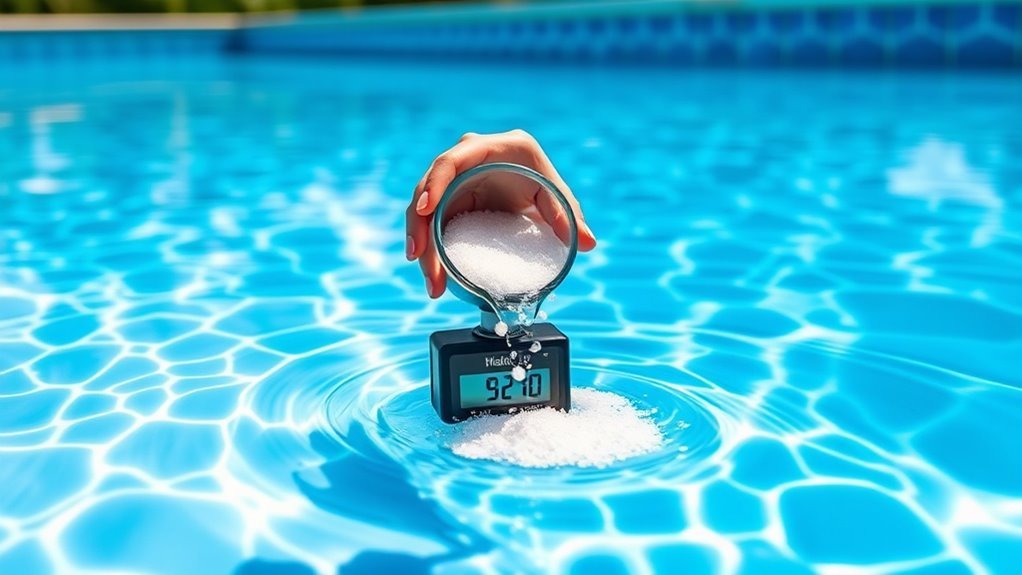
Although saltwater pools rely on salt, they don’t function like traditional salty water. When you add salt to your pool, it dissolves and creates a saline solution.
This solution passes through a salt chlorine generator, which converts the salt into chlorine through electrolysis. The chlorine sanitizes the water, killing bacteria and keeping your pool clean without the harshness of traditional chlorine treatments. You don’t need to add chlorine separately because the system produces it continuously.
Understanding this chemistry helps you maintain balanced water, ensuring the salt level stays effective without being corrosive. Keep in mind, the salt doesn’t make the water taste salty; it’s just enough to generate chlorine safely and efficiently for a more comfortable swimming experience.
Ideal Salt Levels for Different Pool Sizes

Maintaining the right salt level is key to keeping your salt chlorine generator working efficiently. For most residential pools, the ideal salt concentration ranges between 2,700 and 3,400 ppm (parts per million).
Proper salt levels are essential for efficient operation of your salt chlorine generator.
Smaller pools, around 10,000 gallons, typically need about 270 to 340 pounds of salt to reach this range.
Medium-sized pools holding 20,000 gallons require roughly double, about 540 to 680 pounds.
Larger pools, say 30,000 gallons, need closer to 810 to 1,020 pounds.
Keep in mind, your specific generator might have a recommended salt level, so always check the manual.
Adding too little salt reduces chlorine production, while too much can damage equipment.
Tools Needed to Test Salt Levels

Before you add salt to your pool, you’ll need the right tools to accurately measure its current salt levels. The most common tool is a digital salt meter, which provides quick and precise readings.
You can also use salt test strips; they’re affordable and easy to use but slightly less accurate. A conductivity meter is another option, measuring the water’s electrical conductivity to estimate salt concentration.
Whichever tool you choose, make sure it’s designed specifically for pool water to avoid misleading results. Keep your tools clean and calibrated as recommended by the manufacturer to maintain accuracy.
Having reliable equipment ensures you add the correct amount of salt, keeping your pool safe and balanced without the guesswork.
How to Test Your Pool’s Current Salt Concentration
Now that you have the right tools, it’s time to check your pool’s current salt concentration. Start by collecting a water sample from about 18 inches below the surface.
Next, use your salt test kit or digital salt meter according to the manufacturer’s instructions. Compare your results to the recommended salt levels for your specific salt chlorine generator.
Here’s a quick reference table for common salt concentrations and their effects:
| Salt Concentration (ppm) | Effect on Pool Water | Recommended Action |
|---|---|---|
| Below 2500 | Low salt, poor chlorine output | Add salt |
| 2500-3500 | Optimal range | Maintain current level |
| 3501-4500 | High salt, potential corrosion | Dilute with fresh water |
| Above 4500 | Very high, risks equipment | Partial water replacement |
Testing regularly ensures your pool stays balanced and safe.
Calculating the Amount of Salt Required
Once you’ve identified your pool’s current salt level, calculating the exact amount of salt to add becomes straightforward.
First, determine your pool’s volume in gallons. Most pool calculators online can help with this if you’re unsure.
Next, decide on the target salt concentration, usually around 2700 to 3400 ppm, depending on your chlorinator’s requirements.
Subtract the current salt level from the target to find the needed increase.
Then, multiply the pool volume by the difference in salt concentration (expressed in ppm) and convert it to pounds of salt.
Typically, adding 0.1 pounds of salt per 100 gallons raises salt concentration by about 10 ppm.
With this calculation, you’ll know precisely how much salt to add to bring your pool to the ideal level.
Choosing the Right Type of Salt for Your Pool
Although adding salt to your pool is straightforward, choosing the right type of salt is essential for maintaining water quality and protecting your pool equipment. You want salt that dissolves quickly and doesn’t introduce impurities or minerals that could cause scaling or corrosion.
Choosing the right salt ensures quick dissolution and prevents impurities that harm your pool’s water and equipment.
Here’s what to consider when selecting salt for your pool:
- Use high-purity sodium chloride (NaCl), often labeled as “pool salt” or “solar salt.”
- Avoid rock salt or table salt with anti-caking agents and additives.
- Choose salt with at least 99% purity for optimal performance.
- Opt for pellet or granulated salt designed specifically for pools to ensure quick dissolution.
Selecting the right salt helps your chlorinator function efficiently and keeps your pool water clean and balanced.
Preparing to Add Salt Safely
Before adding salt to your pool, you should take a few safety precautions to protect yourself and your equipment. First, wear gloves and eye protection to avoid irritation. Next, ensure your pool’s filtration system is off to prevent damage. Also, avoid adding salt on windy days to stop it from scattering.
| Safety Step | Why It Matters |
|---|---|
| Wear gloves & goggles | Protect skin and eyes from salt |
| Turn off filtration | Prevent salt damage to equipment |
| Avoid windy days | Keep salt from blowing away |
| Use clean, dry salt | Prevent clumping and contamination |
Following these steps ensures a safe, effective salt addition without harming you or your pool system.
Step-by-Step Process to Add Salt to Your Pool
After you’ve taken the necessary safety measures, you can start adding salt to your pool.
Begin by calculating the exact amount of salt needed based on your pool’s volume and desired salinity.
Next, spread the salt evenly around the pool’s perimeter, avoiding piling in one spot.
Then, turn on your pool’s circulation system to help dissolve the salt thoroughly.
Finally, wait several hours before retesting the salt level to ensure it reaches the ideal range.
Calculate salt quantity using pool volume and target ppm
Evenly distribute salt around the pool edges
Activate pool circulation to dissolve salt
Retest salt concentration after a few hours
Tips for Evenly Distributing Salt
When you distribute salt evenly around your pool, you guarantee faster and more consistent dissolution. Start by sprinkling the salt slowly and evenly around the pool’s perimeter, avoiding piles.
Evenly sprinkle salt around the pool’s edge to ensure quick, consistent dissolution without piles.
Use a clean broom or brush to gently sweep the salt across the pool floor, ensuring it doesn’t settle in one spot. If your pool has a circulation system, run it during and after adding salt to help distribute it throughout the water.
Avoid adding salt directly into the skimmer or near the pool’s inlet to prevent damage. Also, add salt on a calm day to prevent wind from blowing it unevenly.
Following these tips helps you maintain balanced salt levels and keeps your pool water clear and comfortable.
Monitoring and Maintaining Salt Levels Over Time
Monitoring and Maintaining Salt Levels Over Time
Although adding salt correctly is essential, monitoring and maintaining proper salt levels over time guarantees your pool stays clean and comfortable. Salt levels can fluctuate due to rain, splash-out, or backwashing, so regular checks are key.
Use a reliable salt test kit weekly to ensure levels stay within the recommended range, usually between 2700 and 3400 ppm. Adjust salt as needed to prevent corrosion or ineffective sanitation.
- Test salt levels at least once a week.
- Add salt gradually, spreading it evenly around the pool.
- Clean your salt cell regularly to maintain efficiency.
- Keep records of salt levels and adjustments for consistency.
Frequently Asked Questions
Can I Use Table Salt Instead of Pool Salt?
You shouldn’t use table salt because it contains additives that can harm your pool equipment. Instead, choose pool salt designed for swimming pools to keep your water balanced and your system running smoothly without damage.
How Does Salt Affect Pool Equipment Lifespan?
Salt can be a bit of a demanding guest for your pool gear; if you don’t manage it right, it might shorten their stay. Proper levels and maintenance help you keep your equipment happy and lasting longer.
Is Saltwater Pool Maintenance Cheaper Than Traditional Pools?
Yes, saltwater pool maintenance is usually cheaper since you spend less on chlorine and chemicals. However, you’ll still need to maintain equipment and monitor water balance.
Costs can vary depending on your pool’s size and usage.
Can Saltwater Pools Cause Skin Irritation?
Yes, saltwater pools can cause skin irritation if the salt levels are too high or if you have sensitive skin.
You’ll want to maintain proper salt levels and shower after swimming to avoid discomfort.
What to Do if Salt Levels Get Too High?
If salt levels exceed 4000 ppm, you’ve doubled the ideal concentration. Time to act! Drain some pool water, refill with fresh water, and retest. This prevents equipment damage and keeps your skin irritation-free.
Conclusion
Just like a master chef seasons a dish to perfection, you’ve learned how to balance your pool’s salt just right. By testing, calculating, and adding salt carefully, you’re creating a crystal-clear oasis that invites relaxation and fun.
Keep an eye on those levels regularly, and your pool will stay as invigorating and inviting as a calm sea on a sunny day. With this know-how, you’re ready to plunge into effortless saltwater maintenance!
Remember, knowing how much salt to add to a swimming pool is key to maintaining ideal salt levels and ensuring your saltwater pool remains sparkling clean and safe for everyone to enjoy.